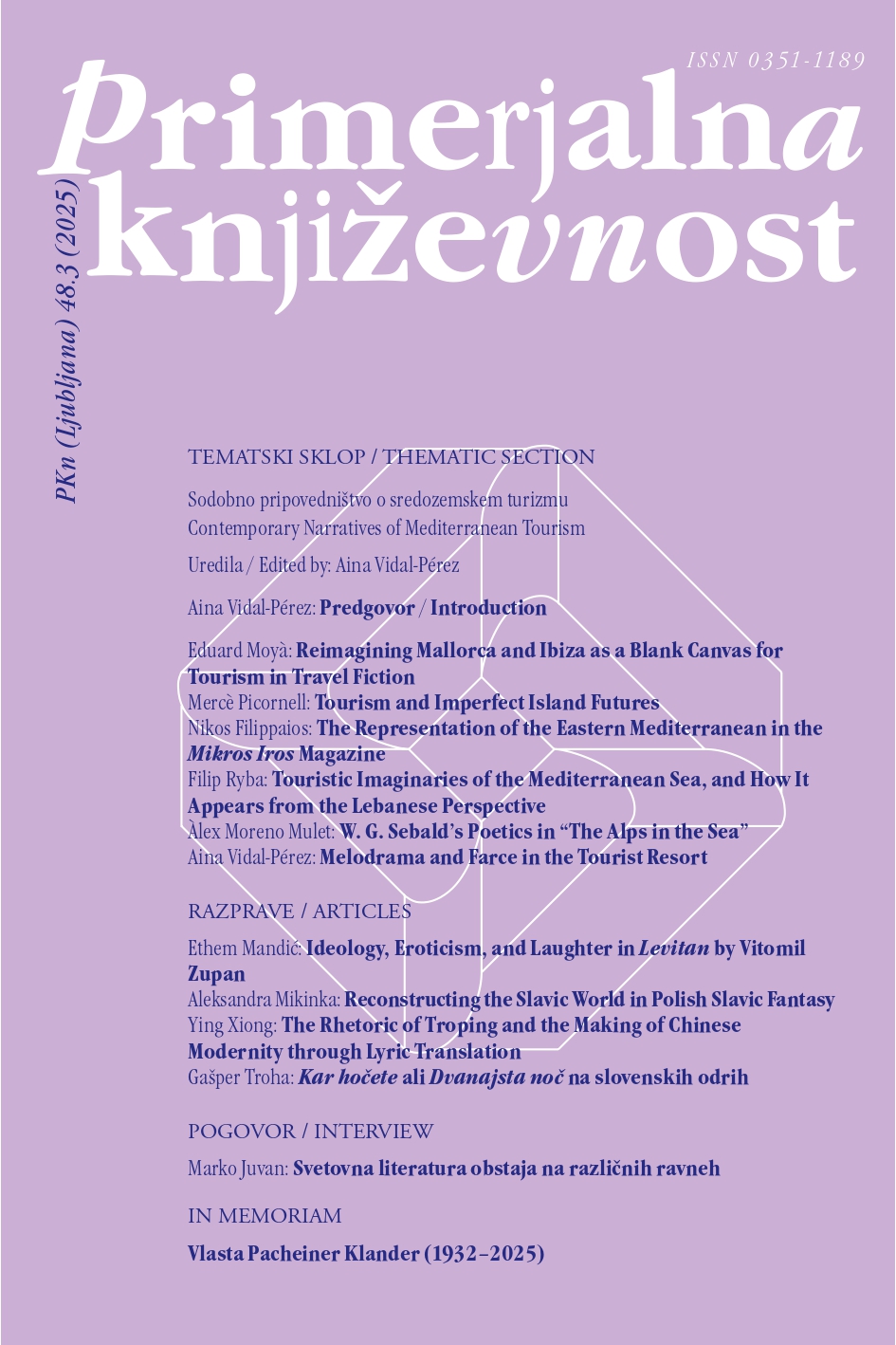
Apostrofiranje Byrona: retorika tropov in ustvarjanje kitajske modernosti skozi prevajanje lirike
DOI:
https://doi.org/10.3986/pkn.v48.i3.09Ključne besede:
angleška poezija, Byron, prevodi v kitajščino, literarni vplivi, apostrofa, mimetična rekonfiguracija, aluzijaPovzetek
Glede na Herderjevo stališče, da je eden od načinov za učinkovito vzpostavitev nacionalne identitete preučevanje pesnikov, ki so sposobni pripovedovati starodavne zgodbe in jih obuditi pred sedanjimi bralci, se razprava osredotoča na nenavadno tehniko apostrofiranja pri prevajanju lirike kot sredstva, s katerim se je angleški romantični pesnik Byron asimiliral v kitajski družbeno-zgodovinski kontekst. Članek se opira na tripartitno teorijo portretiranja Kennetha Burka, ki s »socioanagogičnim načinom analize« teži k umestitvi besedila v »dramo človeških odnosov«, in pokaže, da prevajanje usklajuje dve uporabi apostrofe v lirskih tradicijah: pesniško konvencijo, ki je »ostanek arhaičnih prepričanj«, in optativni označevalec »moči poezije, da nekaj doseže«. Analiza dokazuje, da je Hu Shi (1891–1962) z zavestnim prevzemom arhaizma, namreč z iskanjem dinamične ekvivalence med refrensko besedo xi v sao poeziji, ki izvira iz tradicije Chuci, in apostrofo v zahodni romantični poeziji, interpoliral vzklikalsko tradicijo kitajske poetike v Byronovo pesem »The Isles of Greece« (»Grški otoki«) in se s tem retorično izognil tveganju, da bi vsaka apostrofa postala »klic klica«. Tako se je ustvarila kitajska modernost, bolj problematizirana različica pesmi pa je bila prek besedila v ciljnem jeziku posredovana predvidenemu kitajskemu bralcu.
Literatura
Byron, George Gordon. Don Juan. Edited by T. G. Steffan et al., Penguin Books, 1973.
Cai, Zong-qi, editor. How to Read Chinese Poetry: A Guided Anthology. Columbia University Press, 2008.
Culler, Jonathan. “Apostrophe.” The Pursuit of Signs: Semiotics, Literature, Deconstruction, by Jonathan Culler, Cornell University Press, 2002, pp. 135–154.
Eliot, T. S. “Tradition and the Individual Talent.” Selected Essays, by T. S. Eliot, Faber and Faber, 1932, pp. 13–22.
Even-Zohar, Itamar. “The Position of Translated Literature within the Literary Polysystem.” Poetics Today, vol. 11, no. 1, 1990, pp. 45–51.
Findlay, L. M. “Culler and Byron on Apostrophe and Lyric Time.” Studies in Romanticism, vol. 24, no. 3, 1985, pp. 335–353.
Flatley, Jonathan. Affective Mapping: Melancholia and the Politics of Modernism. Harvard University Press, 2008.
Gibbs Hill, Michael. Lin Shu, Inc.: Translation and the Making of Modern Chinese Culture. Oxford University Press, 2013.
Gu, Sharron. A Cultural History of the Chinese Language. McFarland, 2011.
Guo, Ting. “Translating a Foreign Writer: A Case Study of Byron in China.” Literature Compass, vol. 7, no. 9, 2010, pp. 883–899.
Herder, Johann Gottfried. “Results of a Comparison of Different Peoples’ Poetry in Ancient and Modern Times (1797).” Translated by Jan Kueveler. The Princeton Sourcebook in Comparative Literature: From the European Enlightenment to the Global Present, edited by David Damrosch et al., Princeton University Press, 2009, pp. 3–9.
Holmes, James S. “Forms of Verse Translation and the Translation of Verse Form.” The Nature of Translation: Essays on the Theory and Practice of Literary Translation, edited by James S. Holmes, Publishing House of the Slovak Academy of Sciences, 1970, pp. 91–105.
Hu, Shi. Hushi shicun [Collected Poems of Hu Shi]. People’s Literature Publishing House, 1993.
Kneale, J. Douglas. “Romantic Aversions: Apostrophe Reconsidered.” ELH, vol. 58, no. 1, 1991, pp. 141–165.
Lee, Gregory B. “Other People’s Heroes: Intertexts, History, and Comparative Resistance to Totalization.” Gramma, no. 13, 2005, pp. 115–129.
Lefevere, André. “Mother Courage’s Cucumbers: Text, System and Refraction in a Theory of Literature.” Modern Language Studies, vol. 12, no. 4, 1982, pp. 3–20.
Li, Haotian. “A Hundred Years of Sinicization: The Dissemination and Acceptance of Slovenian Literature in China.” Primerjalna književnost, vol. 47, no. 3, 2024, pp. 141–164.
Maissen, Thomas, and Barbara Mittler. Why China Did Not Have a Renaissance—and Why That Matters: An Interdisciplinary Dialogue. Walter de Gruyter, 2018.
McGann, Jerome. Byron and Romanticism. Edited by James Soderholm, Cambridge University Press, 2002.
Omri, Mohamed-Salah. “A Revolution of Dignity and Poetry.” Boundary 2, vol. 39, no. 1, 2012, pp. 137–165.
Rueckert, William H. “Kenneth Burke’s ‘Symbolic of Motives’ and ‘Poetics, Dramatistically Considered.’” Unending Conversations: New Writings by and about Kenneth Burke, edited by Greig Henderson and David Cratis Williams, Southern Illinois University Press, 2001, pp. 99–124.
Sun, Cecile Chu-chin. The Poetics of Repetition in English and Chinese Lyric Poetry. University of Chicago Press, 2011.
Wang, Ping, and Nicholas Morrow Williams. Southern Identity and Southern Estrangement in Medieval Chinese Poetry. Hong Kong University Press, 2015.
Yu, Chu Chi. “Lord Byron’s ‘The Isles of Greece’: First Translations.” Translation and Creation: Readings of Western Literature in Early Modern China, 1840–1918, edited by David E. Pollard, John Benjamins, 1998, pp. 79–104.